
From Pat Belford:
Anna was the artistic neighbour who lived just around the corner from me in the next street, a lecturer in Art at Leeds Polytechnic, now Leeds Beckett University. One day, around thirty years ago, when I mentioned that I belonged to Leeds Writers’ Circle, she told me that she loved writing and I invited her along to one of our Monday evening meetings. She immediately became an enthusiastic member, eventually joining the committee and in the early 1990s, for two years, she served as Chair.
Anna’s great love was poetry and hers was unique, skilful and profound, though not always easy to comprehend. She also wrote fascinating memoirs about her life and the tales she told of her childhood in Luddenden Foot were pithy and entertaining. She wrote constantly, often late into the night, and she was always keen to share her work. At our meetings, she would invariably produce a handwritten manuscript from the depths of her capacious handbag to read to us all.
An enthusiastic member, she encouraged younger members in their writing and she made many friends. When she entered one of our competitions she was often amongst the winners, and she donated two trophies – the Poetry Plate, and a few years later, a special Innovation Award for exceptional writing of any genre. This latter rapidly became known, in her honour, as the Annavation award!
We all have our own fond memories of Anna. Many of us remember her with love and we delighted in both her art and her writing. She was an exceptionally talented lady, blessed with a rewarding life.
From Chris Read:
When I met Anna at my First Leeds Writers circle meeting, I knew I was going to stay. First impressions count for a lot; At university, I picked up or dropped interests based on how friendly groups were.
Whenever Anna organised anything—when I joined Leeds Writers’ Circle she was the Chairperson—she was excessively keen that everyone was enjoying themselves. She had her opinions on how the Circle should be run but was always so generous and supportive of other’s writing.
On a personal note, she was the first person to read my only completed long fiction, and that led to my first evening of entertainment in what we will all fondly remember as the ‘Annary’, more of which later. She fed me that evening on raspberries, or maybe that was the second visit and the first was avocados. Sometimes it was omelettes. Generous hospitality was abundant, as was supportive critique.
Of Anna’s own writing, she loved her poetry, innovative, dreamlike, somehow concise and wandering, and interlaced with literary references that, somewhat to her consternation, not all of her audience picked up on. If comprehension sometimes eluded some of us, we all enjoyed immensely her Bennettesque memoir pieces about life growing up in Calderdale and her subsequent career as an art teacher. I don’t think I’m alone in regretting we didn’t, in her lifetime, manage to bring these together in one work.
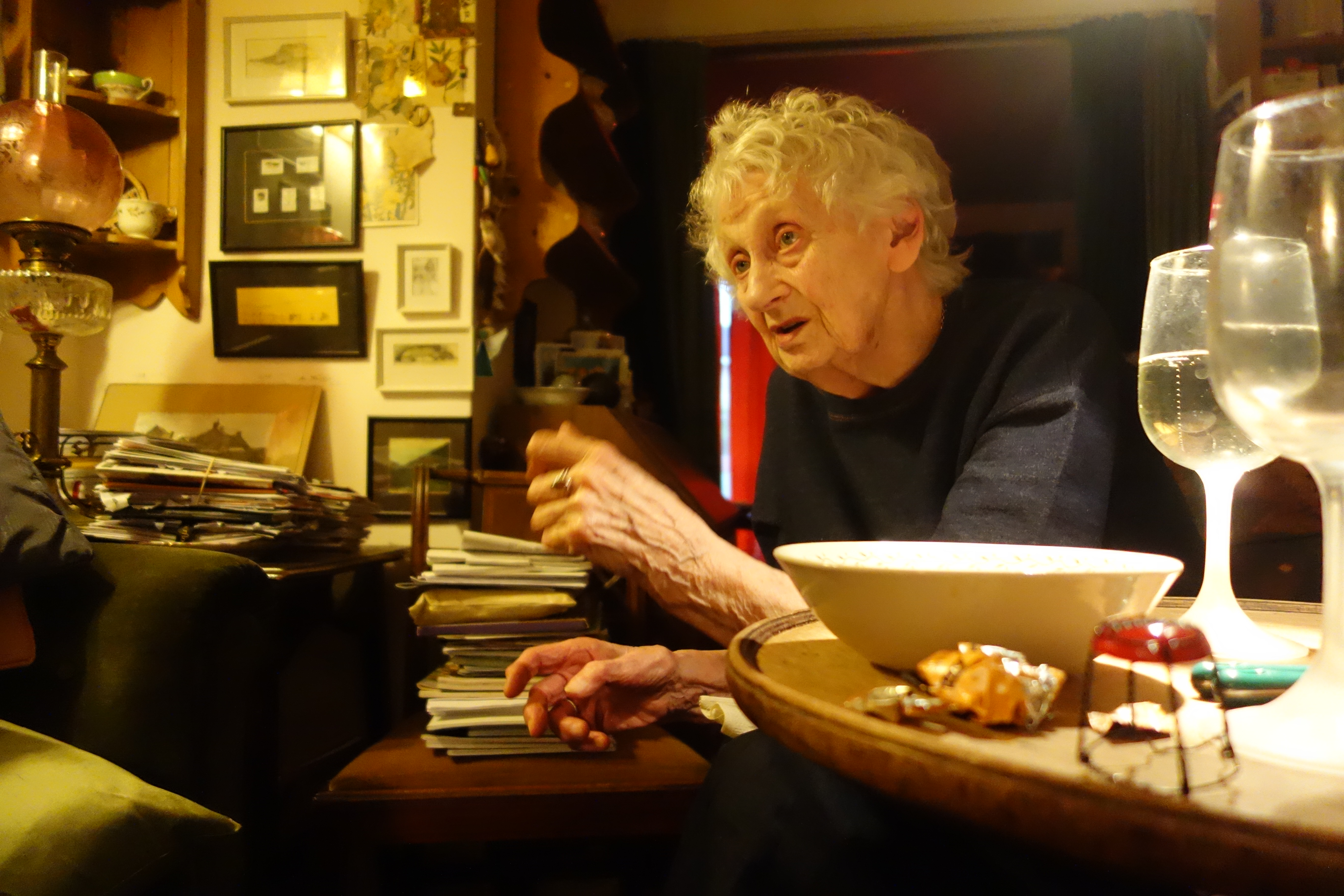
Back to the Annary, where I was entertained, as a one-to-one or with other Circle members, on many occasions after that first visit. Her rooms were warm, learned, somehow cluttered and ordered at the same time. If you knew Anna but not her home, I think that it would be as you imagined. On my last visit, we ate cookies and talked about all our writing. It was New Year’s Eve, 2019 and she’d declared the intention of seeing the new year in with me, a target she had to admit defeat on with tiredness with an hour to go.
Anna would sometimes express almost an apology when it was her turn to read at Circle meetings, a small sign perhaps that she didn’t fully grasp how high a regard we had for her writing … and for her as a friend and a true individual. There are not many people outside of my family for whom I have felt a filial/fraternal love, but one of the few was Anna Sutcliffe.
From Pat Pickavance: The last time I saw Anna …
“What you wrote …” she says eagerly.
I’m taken by surprise, given what I’ve often interpreted as Anna’s indifference to my writing in the past. Though I’m even more surprised at meeting her in Leeds precinct. It’s early spring, afternoon rush hour, the whole world is barrelling towards some chaotic end-of-the day finishing point. I wander out of Leeds Library, my head still in the clouds. Anna is just—there. We literally bump into each other. I in my perennial library scruffs, she, as ever, immaculate in midnight blue.
“Anna!” I say, partly to ground myself and partly to make sure she hasn’t mistaken me for someone else. “How lovely to see you.”
“Well, the same, of course,” she replies, a twist of mirth in her eyes. She goes on, without missing a beat. “But what you wrote … about Euridice…”
“Yes?” Her interest excites me. She’s speaking of a piece of work unfinished, fragmentary, close to my heart. She’s a fully engaged reader. I’m seized with the need at once to please and to challenge. Anna, consummate artist, queen of contradiction, recognises this.
“Well, the thing about Euridice, you see, is that she has no agency,” she goes on breathlessly. “Don’t you think?”
I do. She’s pinpointed the theme I’ve been struggling with. She recalls—almost verbatim—what I read out at the Circle several weeks ago, she’s interested in my difficulties here and now. As teatime crowds mill past us, time stops. We talk animatedly, each needing to go our separate ways, each finding the focus of the moment irresistible.
We speak of having a coffee together in town—soon. When we’ve a little more time.
But it’s early 2020 and we don’t meet again.
From Su Ryder:
Anna was one of the first people I met at Leeds Writers’ Circle. On my first visit, feeling a little nervous, I arrived at the Carriageworks Theatre to find her sitting outside Room 4 with another member, Paul.
My first impression was of evident physical frailty—she told me about the macular degeneration, and the deafness—but her creativity was undiminished despite these physical frustrations. I also soon became familiar with Anna’s sharp sense of humour, emphatic opinions, and wealth of knowledge, together with her great repertoire of memoirs.
Since that time I have been honoured to twice be awarded the Annavation award named in her honour. It’s a unique piece of art and I enjoyed the time it spent displayed in a glass-fronted cabinet in my home. When the time came for the Annavation to go to the next holder, it left a distinct, vacant space behind. And the same is true of the departure of Anna herself. She was a unique part of our Circle and will be very much missed.
From Saverio Armenise:
I met Anna when I joined the Leeds Writers’ Circle, about three years ago. When you are a novice writer and English is not your native language, joining a writing group can be intimidating and no amount of self-confidence can wipe away those initial feelings of nervousness and shyness. But I didn’t need to panic. This is the friendliest, most supportive, and most welcoming bunch of people I have had the pleasure to meet. And then there was Anna, who quickly won me over for her intellectual, but more importantly, personal qualities.
I was dazzled by her knowledge on so many subjects, intrigued by her life experience, and inspired by her natural ability to make you feel a valued member of the writers’ family.
Once, during the mid-session interval at a manuscript evening, while chatting with Anna I mentioned that one of my children lived in London.
“Walthamstow,” I said.
“I know,” she said. “William Morris.”
“Who?” I asked, having never heard of this person before.
She did not bother to explain who Mr Morris was, instead, she started reciting the following phrase: “Have nothing in your house that you do not know to be useful or believe to be beautiful.” Before I could say anything else, she had moved on to speak to another member of the group.
The first thing I did on my return home that evening was to jump on the internet and find out who this William Morris was. And there on the screen, up popped the words Anna had recited. To my astonishment, I realised that she’d been word perfect. Wow!
Her kindness, her encouragement, and her display of affection towards everybody around her are the things for which I will remember her. She will be sadly missed.
From Lucie Warrington:
I was always intrigued and intimidated by Anna and equally inspired and amazed by her knowledge, enthusiasm and creativity. My last proper memory of her was when she made a very rare jaunt to the Vic after a manuscript meeting in November 2019. I sat with her and Ian and listened to her thoughts and opinions on myriad topics. I spoke to Ian afterwards about making a short film with her, a ‘talking heads’ to document her life and experience of the century in which she had lived. Film is my day job and I realised we could make something wonderful, and that she’d likely enjoy it as she loved an audience. It was not to be as 2020 followed soon after.
From Emma Storr:
It’s difficult not to lapse into clichés when talking about Anna. She was unique, a tour de force of intellect and creativity. Her poetry was always fascinating and challenging. I enjoyed reading it out loud for her at the Writer’s Circle when her eyesight deteriorated. She delighted in having friends round for meals and sharing good food and stimulating discussion. Lockdown was particularly hard for her because she thrived on good company and welcoming people to her house. The last time I saw her was when Bob Hamilton and I popped around last summer to take her some flowers and Grasmere gingerbread. She stood on her doorstep in the sun surrounded by tulips and greenery. She was mortified not to be able to take us inside for a cup of tea and entertain us with more of her wonderful stories.
I wish I had met her earlier in both our lives. She will be greatly missed.
A final word from Bob Hamilton with a photograph taken at the famous Annary, May 2019:
Pick any subject in the arts and Anna had a robust and informed opinion. It was as if she had so much in her head that her hands had to enter into the communication to express everything that needed to be said. As many of us will fondly remember—in retrospect, at least—it was hard for her to turn off the tap once the words began to flow. I will always smile now when I recall the reluctance of the Chair to interrupt her at manuscript evenings. That was out of respect for Anna’s intelligence, even as it became ever more rambling, and perhaps also because she was quite intimidating, in the most endearing kind of way. It felt like I had won her respect when I was first invited, with Emma, to the Annary, gaining entry to the inner circle of her literary salon. She held court there in style. It was all wonderfully bohemian.
Anna craved an audience and it proved an unbearable frustration when that was denied her as a result of Covid. Anna, I will miss your intellectual sparkle and especially that twinkle you always had in your eye.
 Leeds Writers Circle