We had 19 entries for this latest competition where the challenge was set by our judge, Becky Cherriman, to write a piece of memoir of 1000-2000 words in any style and on any subject. The adjudication evening was enjoyed by upwards of 25 members, who heard Becky’s detailed and helpful feedback, as well as the winning entries. She had some introductory words for our writers, which she’s happy to allow us to share here. There’s lots of good advice as well as a healthy endorsement of the quality and strength of writing in the Circle. She concluded by suggesting there was indeed so much good material here that we might want to consider compiling an anthology.
“What an honour to be let into your lives. I said in the brief that I looked forward to getting to know you through your writing and I feel that over the three weeks of reading and returning to these memoirs, I have done so. That is thanks to your skill and also your willingness to be a little vulnerable on the page.
“It has been said before that our creative works are our children and, for many of us, when we hand people our words to read, it can be an anxiety-inducing process. With memoir, we are not shrouding what we know in story form, different characters taking the places of ourselves and those we love. We are laying ourselves bare, showing our flaws as well as our triumphs. Some of the pieces that stayed with me most powerfully between readings were those that pulled on my emotions effectively. A few could have benefitted from revealing a little more. But it can be all too easy to be hyper-emotional in writing about our own lives, to dwell on our sorrows and griefs and yes, people want to read about sorrow and grief and yes, there was sorrow and grief here – death and sickness of parents in particular. But there was no pity memoir amongst the selection.
“You looked back with the knowledge gained from experiencing these events, sometimes looking at your younger, more innocent selves with fondness, empathy, or amusement, sometimes with embarrassment or infuriation. The ability to write the young voice convincingly whilst also demonstrating what had been learnt over time was a common strength in this cornucopia of stories. That is to be commended – establishing the right narrative distance is a tricky skill to master. Some entries achieved this more successfully than others.
“It was clear from the first reading that the pieces had been written by experienced writers. Each piece could be held up as an example of one or more techniques or writing strengths. It was clear that finding a winner would not be easy.
“There were common themes – travel – I think between you, every continent apart from Antarctica was visited. You tackled living away from home for the first time – often abroad for work. You explored embarking on different vocations such as teaching and nursing. Motherhood and the maternal line featured strongly as did powerful and painful childhood memories. As might be expected from literary sorts like yourselves, the importance of books in our lives was prominent, such as the role of One hundred years of solitude in helping someone cope with a very difficult time, and the mention of famous writers featured from Graham Greene’s The Heart of the Matter to Shelley’s calcified heart.
“A variety of successful structures were employed – from stories in three parts to braided or dual thread memoirs that wound in different themes. There were those that conformed to more traditional story arcs in which the narrator’s life was irrevocably changed by the event tackled. Satisfying cyclical structures where the ending referred to the beginning were also prominent. Some structures were more meandering or jumped back and forth. Sometimes this was intriguingly done, but it needed meticulous control of the reins to ensure you didn’t lose the reader.
“I was able to vicariously travel with you to new worlds largely because of how well you conjured up settings, a skill that was demonstrated in most pieces submitted. Whether a dormitory hall, domestic setting, fountain in New York, a mill, or Smithfield Hall market, these descriptions were almost universally vivid and original. I also enjoyed the way you used specific details like cockroaches or a narrator’s focus on an object to let us enter into a place and situation.
“Unsurprisingly, a shared love of language shone through. I enjoyed the metaphors – a memory described as a bead on a chain. I especially admired when a writer used words relevant to a particular time or place. Often memoir doesn’t utilise dialogue and sometimes dialect can lose readers, but I was impressed by the courage and ability some of you showed by attempting this. As these pieces showed, peppering in memoir can be highly effective and bring characters and their relationships off the page.
“Memoir is rarely thought of as the most dramatic form of creative writing but there was plenty of action amongst these pieces – stories that kept me in suspense because a lot was at stake for the narrator. Several of the pieces told fascinating stories of someone’s family history or personal life or focused heavily on historical facts about the places they visited. It felt as though these stories could be better targeted at a small and niche audience – people who had followed the same vocation, or one’s own family for example. Often the stories I felt would work best for a wider audience were dramatic, or expanded beyond their own situation to greater social relevance, or were told against the backdrop of social history.
“The titles were impressive and apt. As ever, writers navigated between showing and telling and generally this was successful – specific details helping the reader to go on the journey with you. In places there was too much exposition and sometimes passages could have benefitted from a little more detail – either to link the event with a different point in time, or to emphasise what happened. Pieces were usually very well edited although a few cliches and unneeded adverbs/adjectives slipped in.”
First: Pat Young: Scattered Coals
Second: Lou Harvey: Breast is Best
Third: Linda Fulton: Two Pianos & A Tree
Highly Commended: Philip Tempest: Spinning a Yarn
Annavation Award: James Whittaker: Third Man
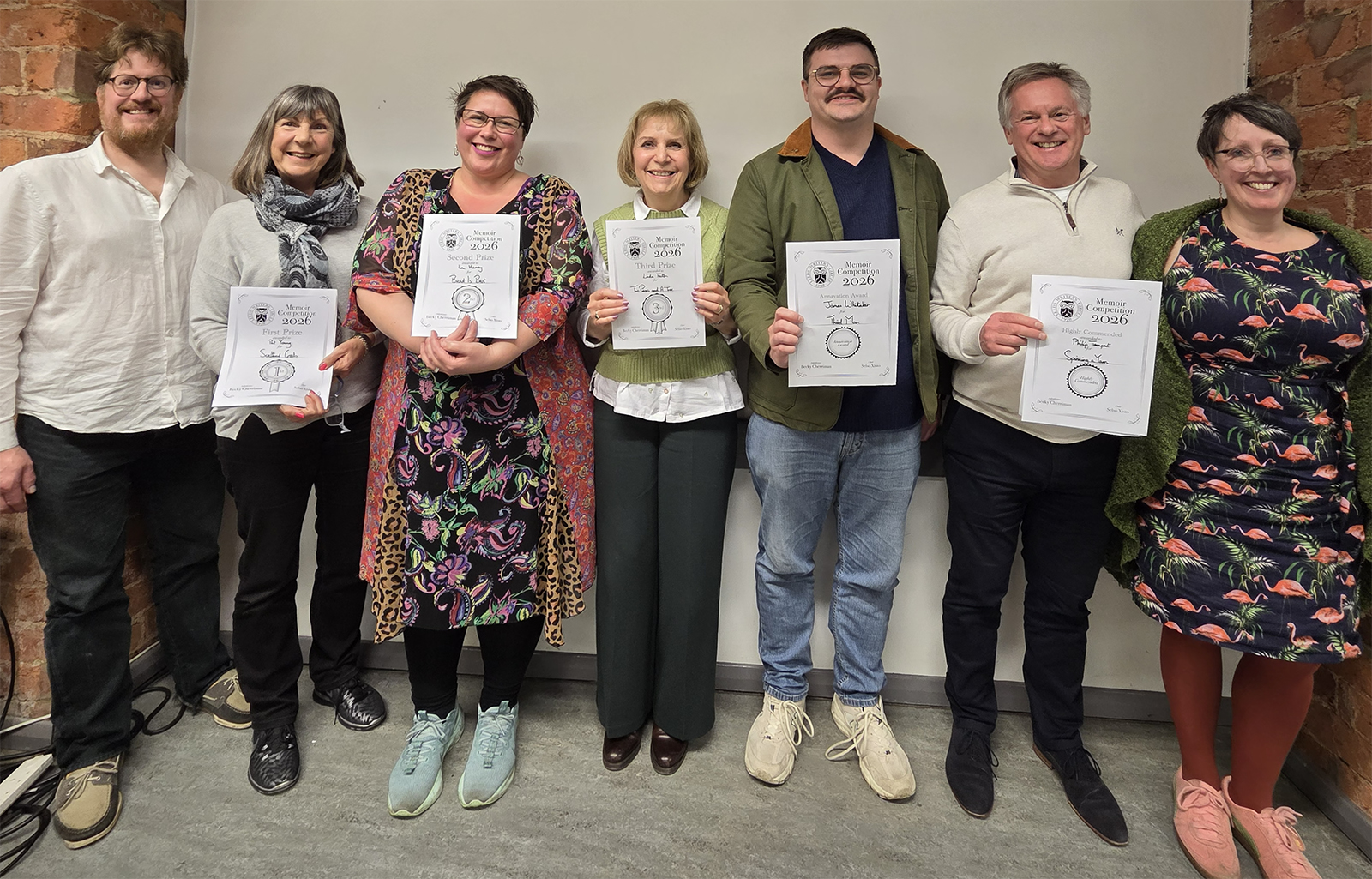
From left to right, competition co-ordinator Alex Offer, Pat Young, Lou Harvey, Linda Fulton, James Whittaker, Philip Tempest, and judge Becky Cherriman. (Photo credit: Selso Xisto)
 Leeds Writers Circle