Monday, July 8th saw the adjudication for our dialogue competition, judged by novelist and poet, Mandy Sutter, and compèred by our new competitions secretary, Emma Storr. No less than 29 members submitted pieces for the competition, providing quite a challenge for our judge. She described the quality of the entries as high throughout and began with providing some very helpful advice in respect to the pitfalls to avoid when writing dialogue, as well as offering a few useful tips. Mandy went on to provide individual feedback for all the people present on the night who had submitted. Finally, we enjoyed readings of the winning dialogues. It all made for a thoroughly stimulating and entertaining evening.
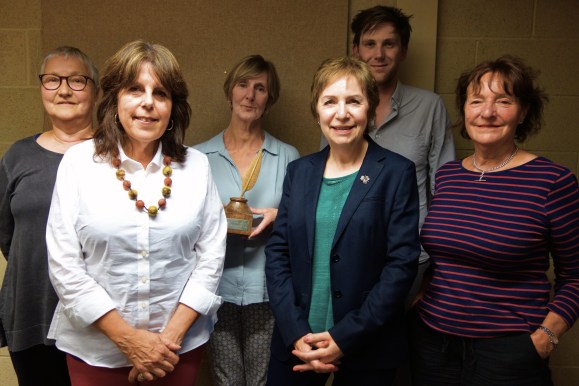
The winning members present on the night (from left to right): Pat Pickavance, Judge Mandy Sutter, Rita Morrison (with winner’s trophy), Linda Fulton, Ian Harker and Jenny Tennant-Jackson.
A Walk with Poetry

Six members of the Circle, plus one guest, took the train to Walsden for a poetry infused walk, a nine-mile route devised and led by Mark Pennington. The main focus of the day was the Rain Stone, an outcrop of ancient gritstone high on the moors alongside the Pennine Way, just north of Blackstone Edge. It’s one of the Stanza Stones and home to the poem Rain by Simon Armitage.
Lunch was taken after a reading of the poem (with thanks to Marg for dispensing emergency bananas to those who forgot to bring anything to eat), before we took a meandering descent down to the Summit Inn for a beer (or two). The ‘summit’ is a reference to the high point on the Rochdale Canal as it crosses the Pennines. Our route along the canal back to Walsden took us past another poem: Andrew MacMillan’s Watershed. It’s situated at the point from which the poem takes its name—rain on the Lancashire side will eventually end up in the Irish Sea; rain falling on the Yorkshire side will flow into the North Sea.
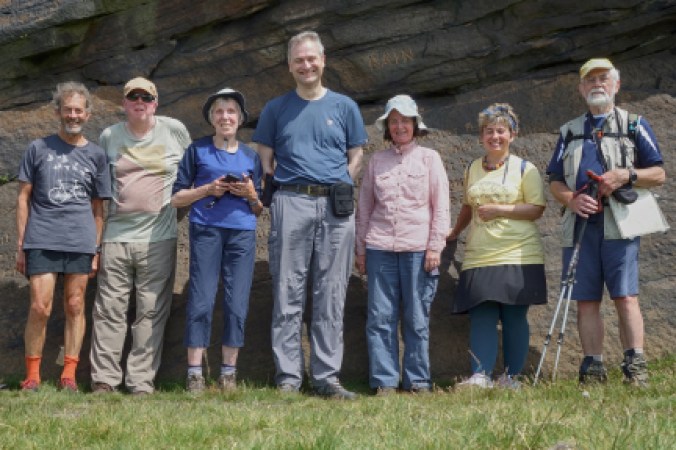
From left to right: Bob, Graeme, Gail, Mark, Marg, Su, John
Many thanks to Mark for the idea and the organisation. The only disappointment was the weather. Our leader singularly failed to deliver any suitably damp weather to do the poems justice. We were instead cursed with blue skies and warm sunshine on what proved to be the hottest day of the year so far.
It is hoped that a summer walk with literary leanings can become an annual tradition for the Circle.
The Winner
We’re thrilled to announce that Sarah Dodd (writing as Sarah Brooks) has been announced the winner of the Lucy Cavendish Fiction Prize for 2019. This may have been less of a surprise for members of the Circle who know her than it was for Sarah herself. In her typically modest way, as we wished her luck at the manuscript evening the Monday before, she dismissed any possibility of actually winning from the short list of seven. We knew better.
The Lucy Cavendish Prize has developed a formidable reputation for uncovering new talent and draws significant interest from the publishing industry. It has been a catalyst for launching numerous literary careers and we’re sure that Sarah will follow in that tradition. Full details here.
Tales of the Fantastic
Success comes in many shapes and sizes and we like to celebrate everything achieved by members here, whatever form that takes – a hint that we can’t publish those achievements unless you tell us about them. Don’t be shy.
We’ve already celebrated some big successes this year and we now have a few others.
Sarah Dodd (writing as Sarah Brooks) has been shortlisted for the Lucy Cavendish Fiction Prize. She’s made the shortlist of seven (from an entry of over 600 submissions) for her novel The Cautious Traveller’s Guide to the Wastelands. You can get a taste of the writing from her competition profile page here. The winner will be announced on May 23rd. We wish her the very best of luck.
Sunyi Dean has had her short fiction piece “-Good“ selected for the 2018 Best of British Science Fiction Anthology. It will be launched at WorldCon in Dublin in August.
Finally, Caroline Humes has her short story A Petitioner Calls currently short-listed for publication in Factor Four Magazine.
A Spring of Success
It’s a pleasure to report that both Pat Belford and Gill Osborne have had more success in placing stories with the People’s Friend. As the longest-running women’s weekly magazine in the world—the first edition appearing in 1869— and with a still growing subscription base, it’s good to know that Pat’s The Early Delivery and Gill’s Double Trouble will be read so widely.
Emma Storr is now officially able to announce the publication date on May 22nd for her debut poetry pamphlet Heart Murmur, published by Calder Valley Poetry (£7.00). The launch event will take place at Seven Arts at 31 Harrogate Road in Chapel Allerton (LS7 3PD), 7.30 – 9.30pm. Also reading will be John Foggin and Carole Bromley. There is a bar, with food available, at the centre. Emma would be delighted to see members on the night to help her celebrate. Full details here.
Finally, Ian Harker and Andrew Lambeth have succeeded again in getting Strix on the Saboteur Awards Shortlist for best magazine. They didn’t win last year but are hoping to go one step further this time around. Although obviously not asking out of blind loyalty, if you are a fan of Strix, they would really appreciate your vote. Cast your mark on the ballot paper here.
Handing over the Gavel
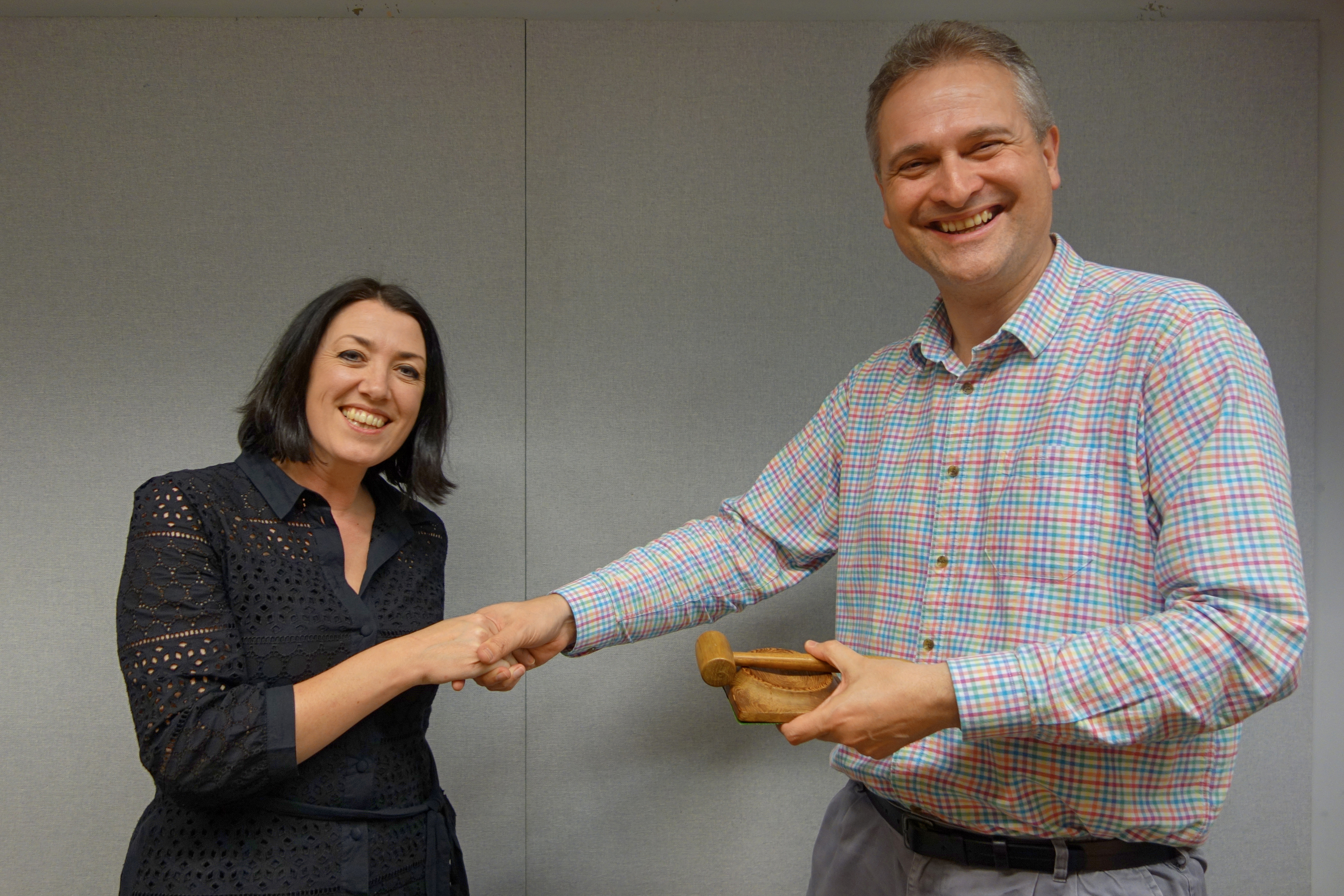
Our new Chair, Lucie Warrington, takes the gavel from outgoing Chair, Mark Pennington.
The evening of March 25th saw a record turnout of 27 members for the AGM. After serving for six or possibly even seven years on the committee, the last two as Chair, Mark Pennington handed the gavel over to Lucie Warrington. It is a testament to Mark’s skill in the role that the meeting was so well attended and also over so quickly. We were able to retire to the pub well before 9 pm. Huge thanks are due to Mark for all his energy and enthusiasm. We now look forwarding to hearing him read more often
Replacing Lucie as Competitions Coordinator is Emma Storr. The only other change to the committee sees Caroline Humes taking over from Andrew Lambeth in the role of Events Coordinator. Many thanks are due to Andrew for his hard work and we still look forward to him running his own occasional, much-celebrated workshops.
Finally, a report of a double success in the publication of Emma Storr’s review of Charlotte Eichler’s debut pamphlet Their Lunar Language in The London Grip.
Read it here.
January Successes
First, a few Circle members were lucky enough to hear Andrew Lambert read as the featured poet of the Rhubarb Open Mic at the Triangle, Shipley on Wednesday, Jan 30th. Congratulations are due for what was acclaimed on the night as a great set and a thoroughly engaging performance.
Gill Osborne recently had her short story Second Chances longlisted for the Henshaw Press short story competition. It has now been accepted for publication later this year by Park Publications in their quarterly magazine Scribble.
Pat Belford has scored another success with The People’s Friend. This latest story, called Counting Sheep, is set in a Victorian country village in Northumberland in very heavy snow. A young man and his girlfriend are able to save the Squire`s sheep when rustlers were plotting to sell them over the Border.
Marg Greenwood has an article about the island of Gigha appearing in the Jan/Feb edition of Scotland Magazine.
Finally, Emma Storr has been featured on John Foggin’s blog (The Great Fogginzo’s Cobweb), introducing her as an (un)discovered gem – although not undiscovered to us, of course. He talks about hearing and listening and showcases a few of Emma’s poems. Read the piece here.
Hot Start
The new year has got off to a hot start with the wonderful news that Andrew Lambeth’s poem Why the swan has just been selected as Guardian Poem of the Week. It’s a huge accolade. Please follow the link to read the poem, along with some hefty analysis. Huge congratulations to Andrew.

Monday, Jan 14th saw the adjudication for our own short story competition, judged by novelist, short story writer and creative writing tutor, Martyn Bedford. Described by the New York Times as “the genuine article, a writer of unmistakable flair and accomplishment”, we felt lucky to have him and he delivered a thoroughly engaging evening of feedback on the submitted stories. Martyn had praise for the high quality of writing across the entire entry for the competition and gave the impression of having thoroughly enjoyed the process of reading them all. Full details of the winners can be seen on the Competitions Page.
Books of the Year, 2018
We asked members to nominate their book of the year for 2018. What was the book you most enjoyed reading, the book you would most heartily recommend to other members of the Circle because you loved it so much. Our reading inevitably informs our writing so it is always fascinating to know what books our fellow writers have enjoyed most. We’d like to think that as well as providing a useful list of recommendations for the new year, this is also an opportunity for members to get to know each other a little better. There is nothing more revealing of who we are than the books we read.
Perhaps not surprisingly, in respect to the diversity of people in the Circle, as well as the vast number of great books out there in the world, each choice was distinct. What is most remarkable, however, is that one particular author had three different books nominated. It is therefore possible to announce that Elizabeth Strout is the unofficial LWC author of the year for 2018.
Starting there, Gill Osborne chose Anything is Possible. Constructed as linked short stories, characters from a rundown rural community in Illinois are depicted with heartbreaking insight. The style is pared back, unsentimental, with barely an adjective in sight. There is sibling rivalry (and love), parental cruelty (and love), poverty, bullying, tears, laughter, pain and healing. Gill recommended reading Strout’s masterpiece ‘My Name is Lucy Barton’ first, for context.
Linda Fulton selected Olive Kitteridge, another Strout novel constructed as a number of short stories with interlinked characters, all revolving around one middle-aged woman in a small east coast community. She described it as full of pathos and humour with insightful character building.
Emma Storr nominated Strout’s first novel Amy and Isabelle. In a similar small town setting, Isabelle is a single mother working in a dull office job and harbouring fantasies about her boss. Amy is her 16-year-old daughter who is discovering the joy and power of sexual encounters. Mother and daughter have a difficult relationship and secrets they want to retain. They both behave badly which makes for fascinating reading as the plot unfolds. Emma suggested that Strout is particularly good at exploring her character’s inner worlds and thoughts as they progress through life, facing the challenges of growing up, relationships and loss.
Two nominations were for novels set in Nigeria.
David Cundall chose Welcome to Lagos by Chibundu Onuzo. He said that he could do no better than reiterate the description from The Guardian’s Gary Younge: “a brilliantly-narrated yarn about camaraderie, inspiration, desperation, corruption and salvation”.
Terry Buchan picked The Secret Lives of Baba Segi’s Wives by Lola Shoneyin, about a polygamous household in Nigeria. Chapters are written from the point of view of each of the four wives and the patriarch. Terry found it entertaining, insightful, humorous and tragic, greatly enjoying Shoneyin’s lively style and sly wit.
A couple of members selected books with a local setting.
Graeme Hall found it easy to plump for The Gallows Pole by Benjamin Myers. A gripping—albeit very dark—account of the Cragg Vale Coiners. Graeme suggested that Myers skilfully balances a recognition of the hardships of the time that led to the coining, with a portrayal of the gang that makes it clear they are no Robin Hood types—all accompanied by stunning nature writing that captures perfectly the Calder Valley. The book went on to win the Walter Scott prize for historical fiction.
Pat Belford chose Streets of Darkness by A.A.Dhand, an original, gritty, crime novel set in Bradford, the first of a series featuring DI Harry Virdee. She admitted to having a special interest because the author is her local friendly pharmacist in Headingley. His subsequent novels in the series, ‘Girl Zero’ and ‘City of Sins’ are also best sellers. Pat added that as key speaker at the Swanwick Writers’ Summer School last August, Amit demonstrated his meticulous attention to plotting by showing the huge spreadsheets on which he had every chapter of his next book described in minute detail.
Staying with the crime genre, Guy Newton said that he’d been working through Susan Hill’s series of crime novels featuring Simon Serrailler. His favourite was The Betrayal Of Trust, the sixth in a series of nine. Guy said the author was well into her writing stride at this point and all her regular characters were fully formed. He thought the plot of this novel was particularly gripping.
Something very different from Krishna Padmanabhan, who nominated The Woman in the Dunes by Kobo Abe, a Japanese work originally published in 1964. He described it as a phenomenal novel about the travails of an amateur entomologist who is offered lodging for the night at the bottom of a sandpit, only to find next morning that he is trapped like Sisyphus or Tantalus. His only companion in that misery is a young woman and their fates become intertwined in an eerie fashion.
Continuing with classic works of fiction, Andrew Davies picked Evelyn Waugh’s Sword of Honour Trilogy, which he first read a hard-to-believe fifty years ago. It follows the course of the second world war through the eyes of Guy Crouchback, a man who feels he has failed in life. Andrew said it is a masterful description of the futility of war, reflected in the largely ignominious actions of the anti-hero.
Joanna Bucktrout picked Helen Dunmore’s Birdcage Walk, although she said it could easily have been any of a number of novels by the same author that she read last year. Jo endorsed the critics who suggest her prose is fluid and lyrical and captures the presence of the past. This was Helen Dunmore’s final novel before she so sadly died in 2017.
Mark Pennington came up with Landscape With Machines by L.T.C. Rolt, the autobiography of an engineer from the first half of the 20th century, observing with enthusiasm and wistfulness the technological and social changes of which he was a part. Mark said that it was very well-written and full of life, as with all Rolt’s books.
A change of genre for the choice of Sunyi Dean. She nominated Borne by Jeff VanderMeer. She suggested that Science Fiction and Fantasy (SFF) doesn’t get much “cred” in the literary world, but Vandermeer’s strong literary edge is now becoming generally accepted. Borne offered her everything she looks for in a speculative fiction novel. It’s set in a post-apocalyptic world overrun by biotech/wetware, all of it as beautiful and ingenious as it is insane and deadly. Two days after finishing, Sunyi said that she was still not okay because she had all the feels for an inhuman murderous tentacle monster. Be warned then. The full review on her blog can be read here.
Staying a little alternative, a suitably quirky choice came from Charlotte Eichler with Poor Things by Alasdair Gray. She described it as a very funny postmodern revision of Frankenstein.
Another intriguing choice came from Roz Kendall, who nominated Time and Time Again by Ben Elton. She said that it may not be exquisite prose but he always picks up the latest mad trend. This time we have time travel. Roz said that she hopes he might latch onto the drone fad for his next book.
Ann Clarke promoted Naomi Alderman’s The Power. She said she loved it, although acknowledged that it’s a novel that has divided opinion— often a sign of a book worth reading. She said to give it a try and see what you think.
Bob Hamilton nominated The Overstory by Richard Powers. He said that it was the kind of book he would love to be able to buy in bulk and give to everyone he knows. It starts with what are eight disconnected short stories, each very different, all quite brilliant, which are then gradually woven together through the overstory of a forest. It’s a compelling read, full of wonderful science and exquisite prose. It’s a novel of such epic design that it inevitably has flaws, but the writing is so good, and of such passion, that Bob thinks they can be forgiven. He wanted to offer a disclaimer by saying that he’s had a lifelong love of trees, which makes him a little biased towards this book.
Other nominations were from Sandra Hogarth-Scott for Angela Carter’s Wise Children, described as weird and wonderful novel writing; from Margaret Greenwood for The Sacrifice by Joyce Carol Oates; from Sandra Burnett for Mothering Sunday by Graham Swift; from Pat Pickavance for Natasha Pulley’s The Watchmaker of Filigree Street; and from Janet Dominey for The Diary of a Bookseller by Shaun Bythell, a random find in the library that she was surprised by how much she enjoyed.
A few members tried to sneak in some poetry as an extra choice. It seems right to give those a quick mention. Perhaps next year, if we deem this exercise a success, we should have a separate poetry section. Sandra Burnett offered The Unaccompanied by Simon Armitage. Charlotte Eichler nominated Venus as a Bear by Vahni Capildeo, described as a joyful poetry collection full of objects, animals, art and the sea. Finally, Emma Storr chose the dazzling Luck Is The Hook by Imtiaz Dharker.
Thanks to everyone who contributed. If you missed the communication, you could still add your choice by adding a comment to this post. And do let us know if you come to read any of the books recommended. Perhaps there’s a challenge here for you to pick one that’s outside your normal sphere of interest, a book that you might not otherwise have chosen to read. Let us know if you do.
Wishing all members a happy new year and great writing—as well as reading—for 2019.
December News
A number of members had pieces published in the latest edition of Strix, including the magazine’s own founders. Ian Harker’s short story Harvest time, as well as Andrew Lambeth’s poems Towpath (tinnitus) and Why the swan, would grace any publication but an assurance was added that all selection of pieces is done blind by different editors. Also featured in this fifth issue were Charlotte Eichler with her poem Cephalophores, Sandra Burnett with her poem Fighter, and Anna Sutcliffe with her poem Magic Mushroom.
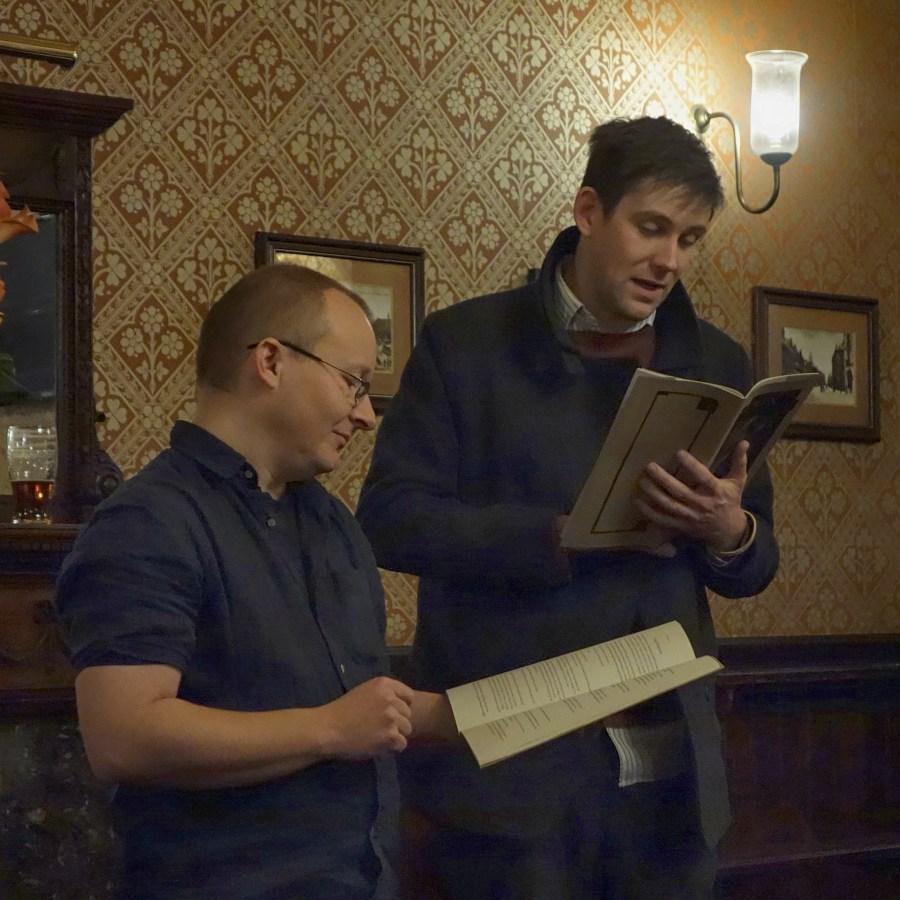
The photograph features what was widely acknowledged as the highlight of the launch evening at the Vic, a performance of a short story by Joe Williams entitled #DogsAtPollingStations, featuring Ian Harker as the voice of the Yorkshireman. For an impromptu, unrehearsed double act, it was brilliant. You really had to be there but it’s well worth reading if you can still get a copy of Strix#5.
The other recent success we’ve heard about is Pat Belford, who has had two stories picked up by The People’s Friend: The Long Road to Bethlehem and Matt’s Snow Trek. Congratulations to her.
And congratulations to all of our members who have had work published this year, as well as to those who write just for their love of the written word and share their work with the Circle on Monday evenings. Merry Christmas everyone. And enjoy your writing in between all the festivities. It can be a great escape.
 Leeds Writers Circle