Memoir Competition Adjudication, March 23rd 2026

We had 19 entries for this latest competition where the challenge was set by our judge, Becky Cherriman, to write a piece of memoir of 1000-2000 words in any style and on any subject. The adjudication evening was enjoyed by upwards of 25 members, who heard Becky’s detailed and helpful feedback, as well as the winning entries. She had some introductory words for our writers, which she’s happy to allow us to share here. There’s lots of good advice as well as a healthy endorsement of the quality and strength of writing in the Circle. She concluded by suggesting there was indeed so much good material here that we might want to consider compiling an anthology.

“What an honour to be let into your lives. I said in the brief that I looked forward to getting to know you through your writing and I feel that over the three weeks of reading and returning to these memoirs, I have done so. That is thanks to your skill and also your willingness to be a little vulnerable on the page.

“It has been said before that our creative works are our children and, for many of us, when we hand people our words to read, it can be an anxiety-inducing process. With memoir, we are not shrouding what we know in story form, different characters taking the places of ourselves and those we love. We are laying ourselves bare, showing our flaws as well as our triumphs. Some of the pieces that stayed with me most powerfully between readings were those that pulled on my emotions effectively. A few could have benefitted from revealing a little more. But it can be all too easy to be hyper-emotional in writing about our own lives, to dwell on our sorrows and griefs and yes, people want to read about sorrow and grief and yes, there was sorrow and grief here – death and sickness of parents in particular. But there was no pity memoir amongst the selection.

“You looked back with the knowledge gained from experiencing these events, sometimes looking at your younger, more innocent selves with fondness, empathy, or amusement, sometimes with embarrassment or infuriation. The ability to write the young voice convincingly whilst also demonstrating what had been learnt over time was a common strength in this cornucopia of stories. That is to be commended – establishing the right narrative distance is a tricky skill to master. Some entries achieved this more successfully than others.

“It was clear from the first reading that the pieces had been written by experienced writers. Each piece could be held up as an example of one or more techniques or writing strengths. It was clear that finding a winner would not be easy.

“There were common themes – travel – I think between you, every continent apart from Antarctica was visited. You tackled living away from home for the first time – often abroad for work. You explored embarking on different vocations such as teaching and nursing. Motherhood and the maternal line featured strongly as did powerful and painful childhood memories. As might be expected from literary sorts like yourselves, the importance of books in our lives was prominent, such as the role of One hundred years of solitude in helping someone cope with a very difficult time, and the mention of famous writers featured from Graham Greene’s The Heart of the Matter to Shelley’s calcified heart.

“A variety of successful structures were employed – from stories in three parts to braided or dual thread memoirs that wound in different themes. There were those that conformed to more traditional story arcs in which the narrator’s life was irrevocably changed by the event tackled. Satisfying cyclical structures where the ending referred to the beginning were also prominent. Some structures were more meandering or jumped back and forth. Sometimes this was intriguingly done, but it needed meticulous control of the reins to ensure you didn’t lose the reader.

“I was able to vicariously travel with you to new worlds largely because of how well you conjured up settings, a skill that was demonstrated in most pieces submitted. Whether a dormitory hall, domestic setting, fountain in New York, a mill, or Smithfield Hall market, these descriptions were almost universally vivid and original. I also enjoyed the way you used specific details like cockroaches or a narrator’s focus on an object to let us enter into a place and situation.

“Unsurprisingly, a shared love of language shone through. I enjoyed the metaphors – a memory described as a bead on a chain. I especially admired when a writer used words relevant to a particular time or place. Often memoir doesn’t utilise dialogue and sometimes dialect can lose readers, but I was impressed by the courage and ability some of you showed by attempting this. As these pieces showed, peppering in memoir can be highly effective and bring characters and their relationships off the page.

“Memoir is rarely thought of as the most dramatic form of creative writing but there was plenty of action amongst these pieces – stories that kept me in suspense because a lot was at stake for the narrator. Several of the pieces told fascinating stories of someone’s family history or personal life or focused heavily on historical facts about the places they visited. It felt as though these stories could be better targeted at a small and niche audience – people who had followed the same vocation, or one’s own family for example. Often the stories I felt would work best for a wider audience were dramatic, or expanded beyond their own situation to greater social relevance, or were told against the backdrop of social history.

“The titles were impressive and apt. As ever, writers navigated between showing and telling and generally this was successful – specific details helping the reader to go on the journey with you. In places there was too much exposition and sometimes passages could have benefitted from a little more detail – either to link the event with a different point in time, or to emphasise what happened. Pieces were usually very well edited although a few cliches and unneeded adverbs/adjectives slipped in.”

First: Pat Young: Scattered Coals

Second: Lou Harvey: Breast is Best

Third: Linda Fulton: Two Pianos & A Tree

Highly Commended: Philip Tempest: Spinning a Yarn

Annavation Award: James Whittaker: Third Man
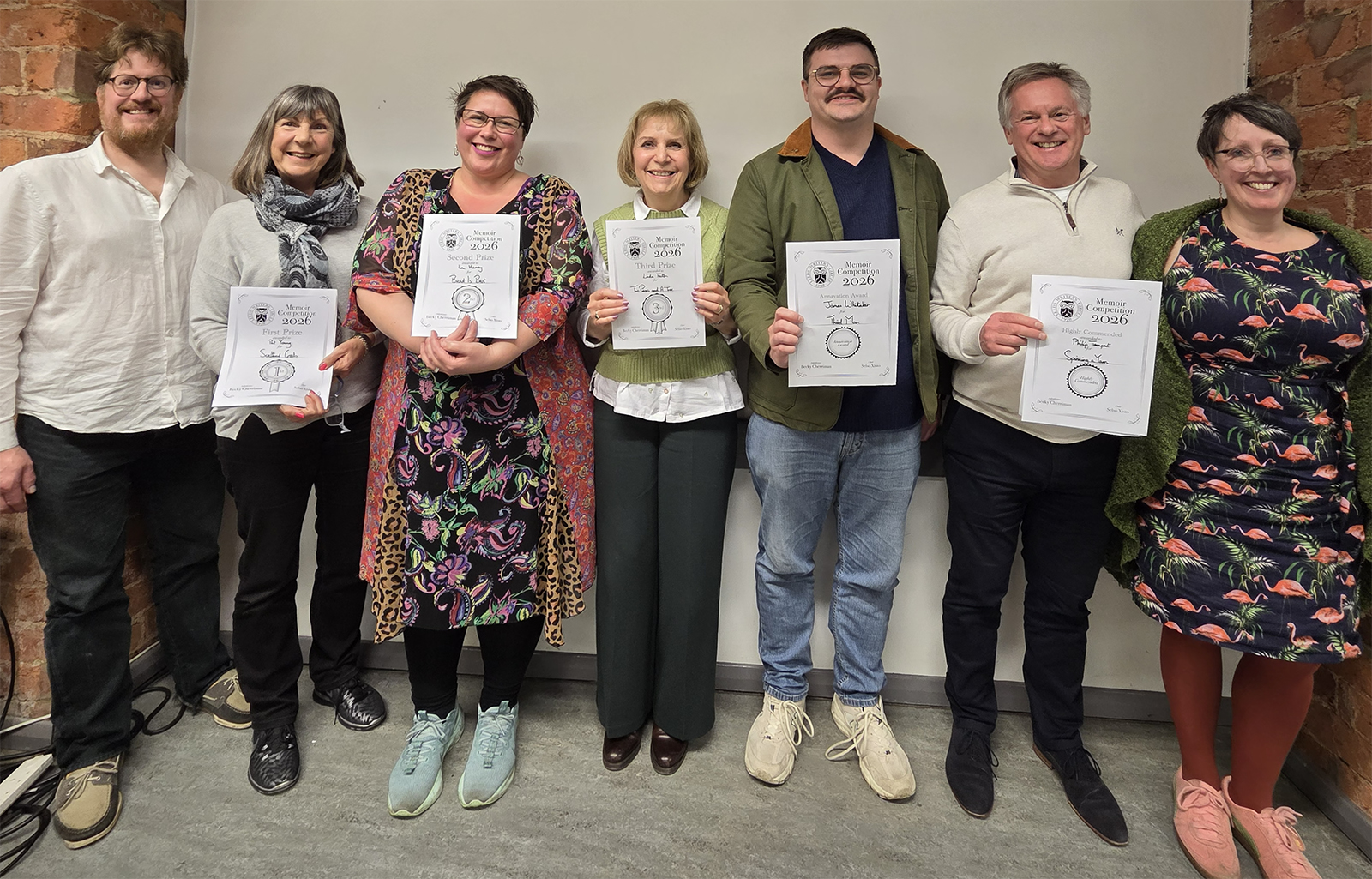
From left to right, competition co-ordinator Alex Offer, Pat Young, Lou Harvey, Linda Fulton, James Whittaker, Philip Tempest, and judge Becky Cherriman. (Photo credit: Selso Xisto)
Summer Socials 2025

Ellie Adams organised two socials this August. The first event, an open mic night, was a great success, with about 20 members present to hear a typically wide variety of readings, with lots of time to chat in between and afterwards, quite late into the evening. The idea was to read a favourite passage or story or poem. For your interest, here is a list of who read what. Some ideas for future reading, perhaps?

Ellie Adams – an extract from The Thought Gang by Tibor Fischer

Emma Storr – short story extract (with lots of swearing) from Dark lies the Island by Kevin Barry

Chris Read – selected paragraphs from Dishonesty is the Second Best Policy by David Mitchell

Jaspreet Mander – poems: Sounds of the Day and Rag and Bone by Norman MacCaig

Bob Hamilton – short story: The Weight of Dunlins, by Colin Watts

Miriam Moss – a number of poems from Michael Rosen

Richard Wilcocks – poem: Campo dei Fiori by Czeslaw Milosz

Linda Fulton – flash fictions from My Mother was an Upright Piano by Tania Hershman

Graeme Hall – the finish to The Great Gatsby by F. Scott Fitzgerald

Susie Beever – extract from Orbital by Samantha Harvey

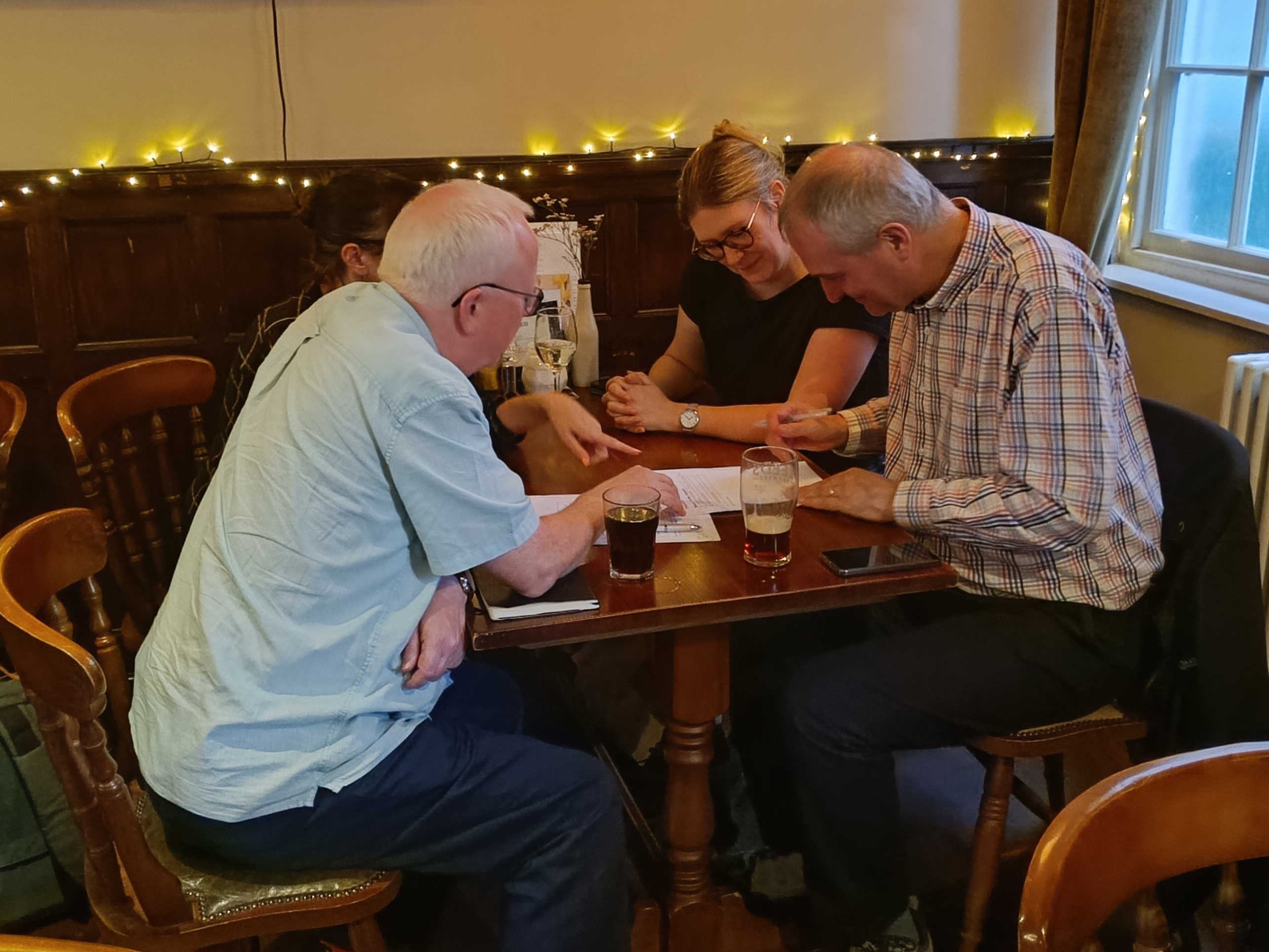
The second event was a quiz compiled by Francis Maietta, and was again a great success, with 5 teams of quiz goers who identified themselves as Alexander Dumas, So Long and Thanks for All the Quiz, The Old Vic Stalwarts, We’re Post Genre Anyway? and The Orwellians.

The winning team with a whopping 78 points out of 100 was The Old Vic Stalwarts (Sarah, Graeme, Lucie and Mark, pictured above, deep in consultation), who will each be taking home a £5 book voucher. It was a close second for The Orwellians who totalled 73 points. A huge thank you goes to Francis for creating such an enjoyable quiz and for being the evening’s quiz master. The teams of We’re Post Genre Anyway? and Thanks for All the Quiz possibly deserved prizes for their names alone.

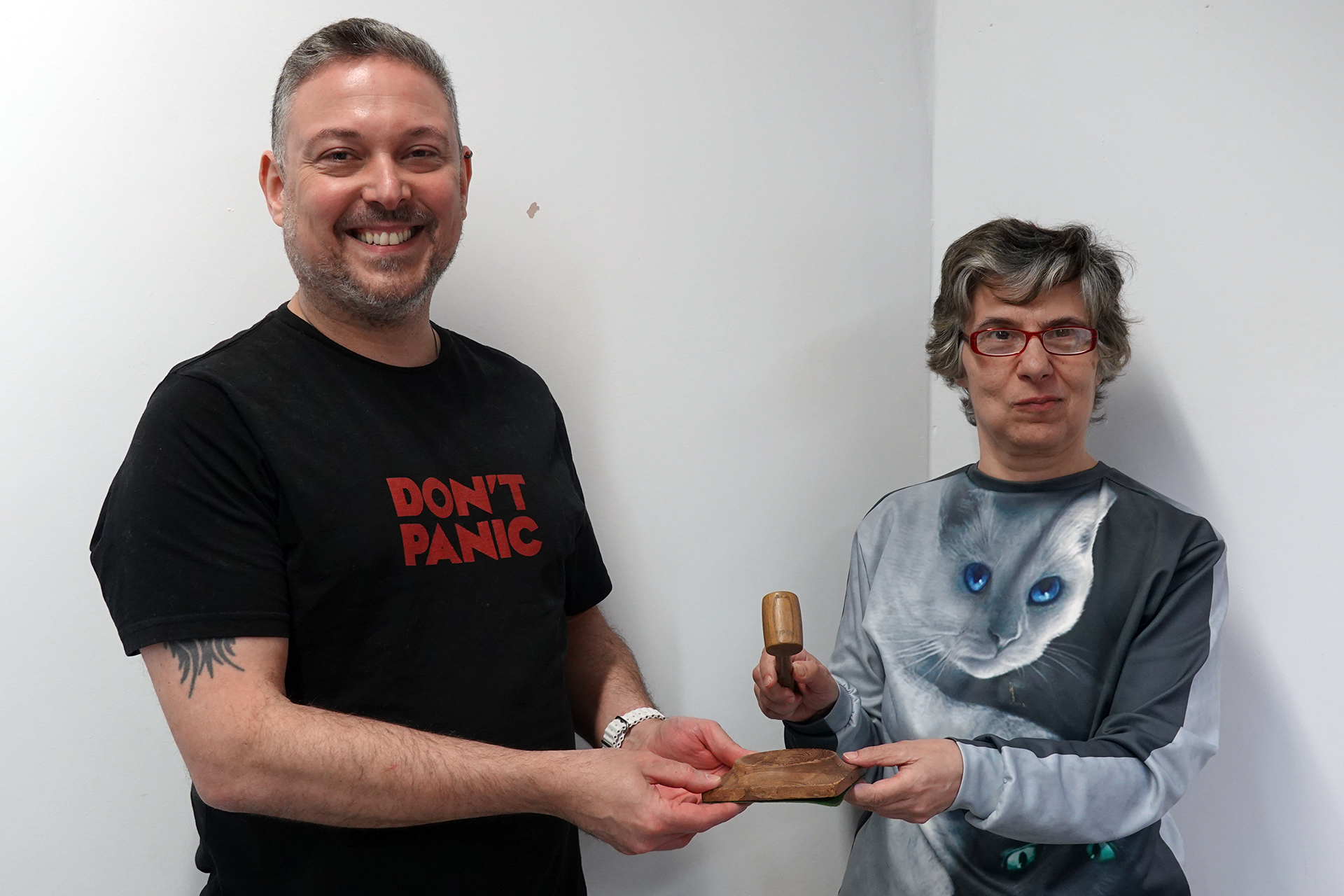
Don’t panic, the gavel’s in safe hands

Selso, the newly elected Chair, receives the gavel from Miriam, the outgoing Chair.

At a lively and entertaining AGM last night, which went the full distance to 9.30pm, Selso Xisto was elected to be the new Circle Chair, taking over after a three year stint from Miriam Moss, who steered our course through a tricky time post-Covid, leaving the Circle in excellent health. After receiving the gavel, in typically unconventional fashion, Selso offered us a heartfelt poem. He didn’t really need to apologise to the actual poets in the Circle! Most of those attending found their way to the pub afterwards and it was unanimously agreed that the Circle is indeed in safe hands.

The Circle

It’s just a hobby, it won’t pay the bills
You need a real job with marketable skills
Get your head down, chase that promotion
But… this isn’t the life I’d have chosen

I’m OK with being a weirdo, the only one in the room
whose mind is elsewhere, like a castle, a tomb
or a ship, a meadow, a nebula, or a plane
anywhere to escape the dull, the mundane

I’m used to the polite smile, the change of subject
I know you’re not interested in my little project
Imagine a world where everything I write
Is greeted with applause and smiles of delight

But that’s not how it works. You don’t care, that’s OK
No one wants to hear what I have to say 
So I scribbled my stories just for myself
Fantasised about seeing my book on that shelf

I could be ‘normal’. I could pretend
But inside, I’d be waiting for the smalltalk to end
Then one day, a Circle changed my life forever
A room full of weirdos, their minds full of treasure

You… want to hear my story? Do you really? Are you sure?
But it’s rubbish, it’s a first draft, I’m being premature
It’s alright. We understand. You’re not the only weirdo around here
Our characters are real to us too, we’ll lend you an ear

Pantsers and plotters, poems and prose
Novelists, doodlers, amateurs and pros
Semicolon or em-dash, bold or italic
Even brackets or an asterisk, though emoji are… problematic

I’ve found a planet where I can breathe without a mask
Brilliant, creative minds, happy to help if you ask
This Circle means more to me than my words can describe
My search is over. I have found my tribe

Successes since the beginning of 2024

Posting this at the end of March 2025, there are 15 months to catch up with since our last Successes post. Time flies. As we did in 2023, post-Covid, we put on a number of member-led workshops, all of which proved to be entertaining and very helpful to members. We are privileged as an organisation to have so much in-house talent and expertise to draw upon. Huge thanks to the following leaders involved.

March 2nd: USING SCRIVENER – Led by Selso Xisto
Nov 9th: HISTORICAL FICTION: FACTS AND FANTASY – Led by Sarah Dodd
Jan 11th: THE BEWILDERED WRITER’S GUIDE TO WORLDBUILDING – Led by Luc Biyard

Undoubtedly, the major success to report is the publication of Sarah Dodd’s The Cautious Traveller’s Guide to the Wastelands, by Weidenfeld & Nicolson, under her writing name of Sarah Brooks. At one point it was No.9 on the Sunday Times Bestsellers List for Hardback Fiction and one place ahead of Stephen King! Sarah’s novel has garnered some wonderful reviews. For newer members and anyone coming across this by chance, this one from the Guardian will give you a flavour.

Also, with the release of his latest novel, The Fairfax Redemption, Chris Shevlin has now topped lifetime sales of 100,000 on the Amazon platform. It’s a huge achievement and an inspiration for us all in that you don’t necessarily have to go down the traditional publishing route to achieve success—although it certainly helps to be as talented as Chris.

It took a bit of prising from Chris to discover that he was on the very short longlist for the Bath Novel Award for 2024, one of the most prestigious novel competitions around.

Quite a few of us in the Circle are plugging away at our unpublished novels, writing, editing, honing drafts, generally putting in the hard yards, any kind of success feeling like only a distant possibility. It’s lovely to be able to report then that three members have recently been recognised in separate novel competitions. Panni Loh is currently longlisted in a major one. Gemma Irving Lees was shortlisted for Picasso Among the Pigeons in the Farnham Literary Festival’s First Five Pages Competition. And Bob Hamilton was shortlisted for The Strange Talent of Madeleine Mallarkey in Retreat West’s Opening Chapter Competition.

On to short stories and it feels like it’s becoming harder and harder to get a piece published and out there into the world. That said, Stephanie Soper has had no less than seven short stories published in the Sayings of Life anthology by Spilt Ink. Panni Loh has had Chickens, Wolves and Lightning published in the Nightmare with a Twist anthology by Barrio Blues Press, as well as a flash fiction, Winter Solstice, published on Paragraph Planet. Mari Phillips has had three flash pieces published on Cafe Litlove you lots on 27 March, Number thirty-five on 30 April, and A Shoe Story on 20 August. Mari also had Obituary published on Paragraph Planet.

Members have had a couple of articles published in the year. Graeme Hall had a piece published in The Author—the house magazine of the Society of Authors—on Ageism in Publishing. Stepanie Soper had a half-page spread commissioned by the Phuket News, on how to be a writer. Also, Emma Storr continues to get published on The London Grip with a number of poetry reviews.

Moving on, then, to poetry, Emma was placed 2nd with On Seaham Beach in this year’s Molecules Unlimited Poetry Competition, judged by no less than Imtiaz Dharker. This was a poem previously offered for critique at a Circle meeting and tweaked accordingly. Emma also had three children’s poems published in the Dirigible Balloon, accompanied by some of Su Ryder‘s artwork. Richard Wilcocks had his ekphrastic poem, Newport Tip—inspired by a photo of Tish Murtha’s—published in The Fig Tree Webzine.

Finally, no less than six members had poems published in Chapel FM’s 2024 collection with the theme of Recovery—Ann Clarke with Sweetest Hangover, Ben Grunwell with A Fallen Writer’s Philosophy, Gail Mosley with Missing on the Remarkables, Jaspreet Mander with Worlds and Wardrobes, Marg Greenwood with Buoys will be Buoys, and Terry Buchan with Charity Shop.